
3 Ways to Prove Your Agency's ROAS to Skeptical Candidates (Without Faking It)
3 Ways to Prove Your Agency's ROAS to Skeptical Candidates (Without Faking It)

You're sitting across the table from a campaign manager who has been burned before. They’ve watched previous consultants blow five figures on untargeted cable spots with zero receipts, leaving the campaign chest empty and morale in the gutter.
Now, they’re staring you down and asking the ultimate question: "If we give our digital budget to your agency, what is our exact return on ad spend?"
For a small political agency with 1 to 10 team members, answering this question can make or break your pitch. Traditional commercial metrics won’t cut it in politics, and pretending votes equal e-commerce checkouts will destroy your credibility instantly. You can't fake political attribution, but you can master it.
Here’s why proving your value is non-negotiable, and here’s how you can walk into your next pitch armed with bulletproof proof.
1. Redefine ROAS for the Ballot Box
Never let a candidate evaluate political digital ads using commercial metrics.
When managing tight campaign funds, treating return on ad spend strictly as e-commerce revenue ignores the reality of modern campaigns. Instead, you need to reframe the conversation around three specialized political metrics that capture actual movement:
- Fundraising ROAS: Direct online donations generated per dollar of ad spend. When running targeted acquisition ads, you can track every single dollar flowing back into the donor portal.
- Supporter & Action ROAS: Valuing volunteer signups, petition signatures, and event RSVPs. If a supporter commits five hours of phone banking because your CTV ad hit them at home, that's measurable campaign value.
- Persuasion ROAS: Measuring incremental voter movement and favorability lift between exposed and unexposed audiences using advanced modeling.
If you fail to establish these metrics on Day 1, you will spend election night defending your invoices instead of celebrating victories.
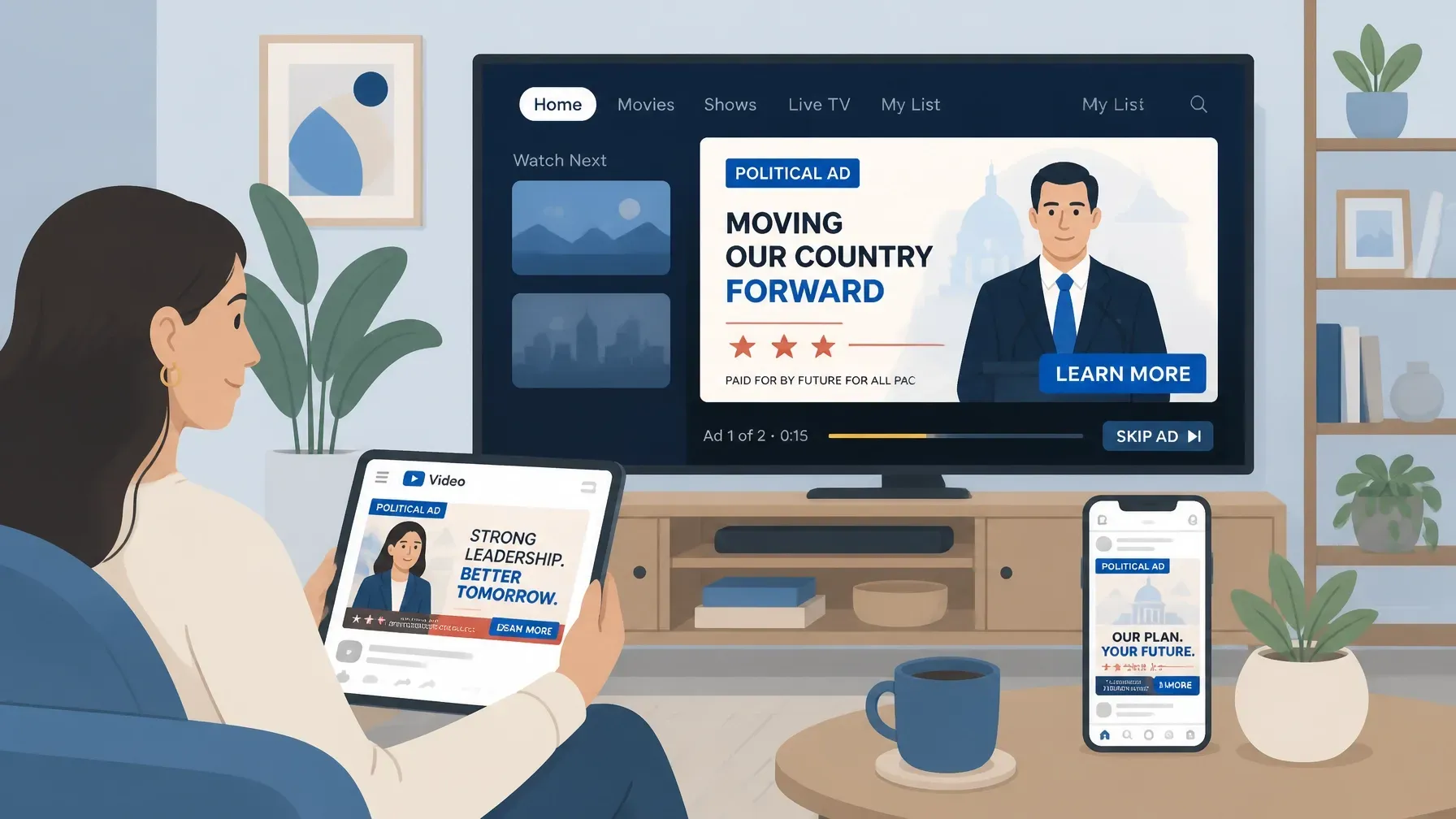
When you leverage a platform like Turn It Blue Ads , you aren't just buying generic media, you're harnessing a full programmatic ad suite covering display, online video, audio, and connected TV (CTV) that tracks precise audience actions across every device.
2. Ditch Static PDF Reports for Real-Time Transparent Dashboards
Stop forcing candidates to wait until Friday afternoon for a cobbled-together PDF report.
Skeptical candidates hate guessing where their money went. If your agency is manually pulling CSVs from three different ad servers and stitching them together in Excel, you’re wasting precious hours and inviting doubt.
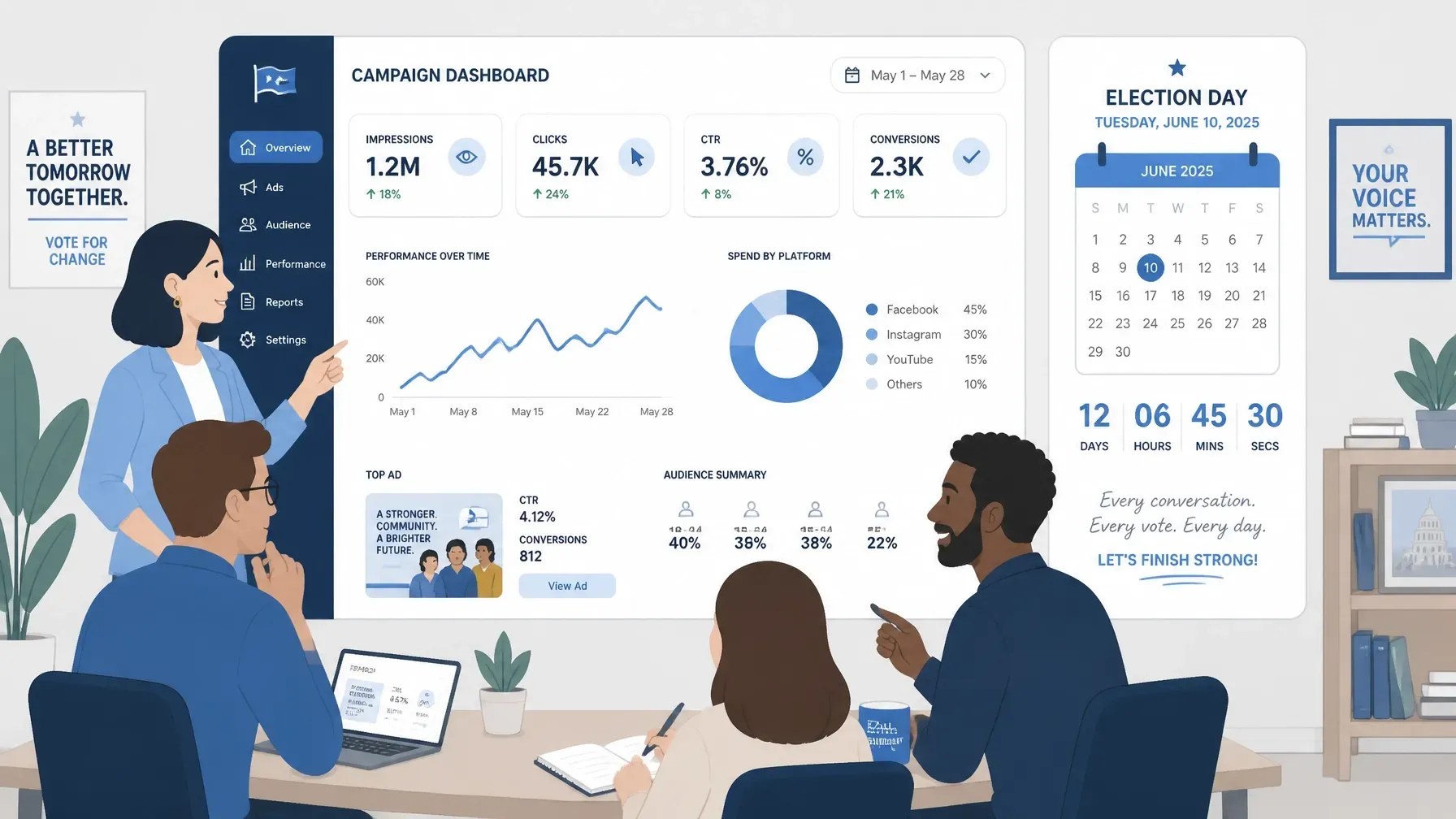
Transparency is your best defense against skepticism. Give your clients 24/7 access to live reporting dashboards where they can log in at midnight and see exactly how many target voters have been reached across Hulu, Roku, CNN, and mobile apps.
Here's how to implement real-time reporting:
- Centralize your data streams: Consolidate your CTV, mobile, display, and video campaigns into a single meta-DSP engine.
- Grant immediate access: Let campaign managers view impression frequencies, reach percentages, and pacing without asking for permission.
- Automate exports: Make data downloads effortless so finance directors can sync ad spend with field reports instantly.
When clients can see their metrics in real time, anxiety drops and trust skyrockets.
As a 2025 Reed Award winner for 'Best Political Service Team' (awarded by Campaigns & Elections Magazine), we know firsthand that giving campaigns total clarity is what turns a one-off client into a multi-cycle partner. Plus, agencies partnering with us can earn up to 5% annual dividends based on their ad spend!
3. Leverage Top-Tier Data Attribution (L2 and Tunnl)
Guesswork in voter targeting is a fast track to wasted campaign funds.
Candidates don't want to hear that their ads "probably" reached likely voters. They want to know that your targeting was backed by gold-standard data infrastructure.
This is where integrating industry-leading data partners transforms your agency's pitch. By prioritizing advanced audience intelligence providers like Tunnl alongside robust voter files from L2 , you can build custom audience segments that pinpoint exact persuasion and turnout universes. 💥
Here’s how top agencies use data attribution to prove ROAS:
- Exposed vs. Unexposed Analysis: Measure the exact lift in voter favorability among audiences who saw your ads versus control groups who didn't.
- Precise Frequency Caps: Ensure voters see your message 8 to 12 times, enough to drive retention without causing ad fatigue or wasting budget.
- Multi-Channel Synergy: Connect high-impact CTV awareness ads with mobile retargeting to close the persuasion loop seamlessly.
Competitors who rely on gut feelings will always lose to agencies that bring empirical data to the table.
Even with a modest budget starting at a $500 minimum to launch, you can deploy sophisticated audience segmentation that rivals national committees.

Bottom Line: Win the Trust, Win the Race
Proving your agency's ROAS to a skeptical candidate isn't about smoke and mirrors, it's about rigorous metrics, absolute transparency, and elite data partners.
When you redefine political ROAS, provide 24/7 dashboards, and anchor your strategy in trusted voter data, you stop pitching and start partnering. Campaigns compete on budget, but efficiency and precision make smaller budgets punch way above their weight class on our platform.
Ready to scale your agency's impact and deliver undeniable results this cycle?
Share this Content!