CTV CPM Reality Check: What Political Campaigns Actually Pay in 2026 (and How to Keep Costs Down)
CTV CPM Reality Check: What Political Campaigns Actually Pay in 2026 (and How to Keep Costs Down)
![[HERO] CTV CPM Reality Check: What Political Campaigns Actually Pay in 2026 (and How to Keep Costs Down)](https://cdn.marblism.com/6GSh_bs6hls.webp)
Let's talk about the elephant in the room: nobody wants to tell you what CTV ads actually cost.
Every agency and vendor has a reason to keep pricing vague. They'll talk about "custom solutions" and "it depends on your goals" until you're ready to give up. But here's the truth, CTV pricing isn't rocket science. It's predictable, scalable, and way more affordable than traditional broadcast TV.
If you're running a campaign in 2026, you need to know what you're actually paying. No smoke. No mirrors. Just real numbers.
What Campaigns Are Actually Paying for CTV in 2026
Political campaigns are paying $18-80 CPM for Connected TV ads depending on inventory quality, targeting tightness, and avails. Most programmatic buys land in the $25-45 CPM range, which means you're paying $25-45 for every 1,000 ad views.
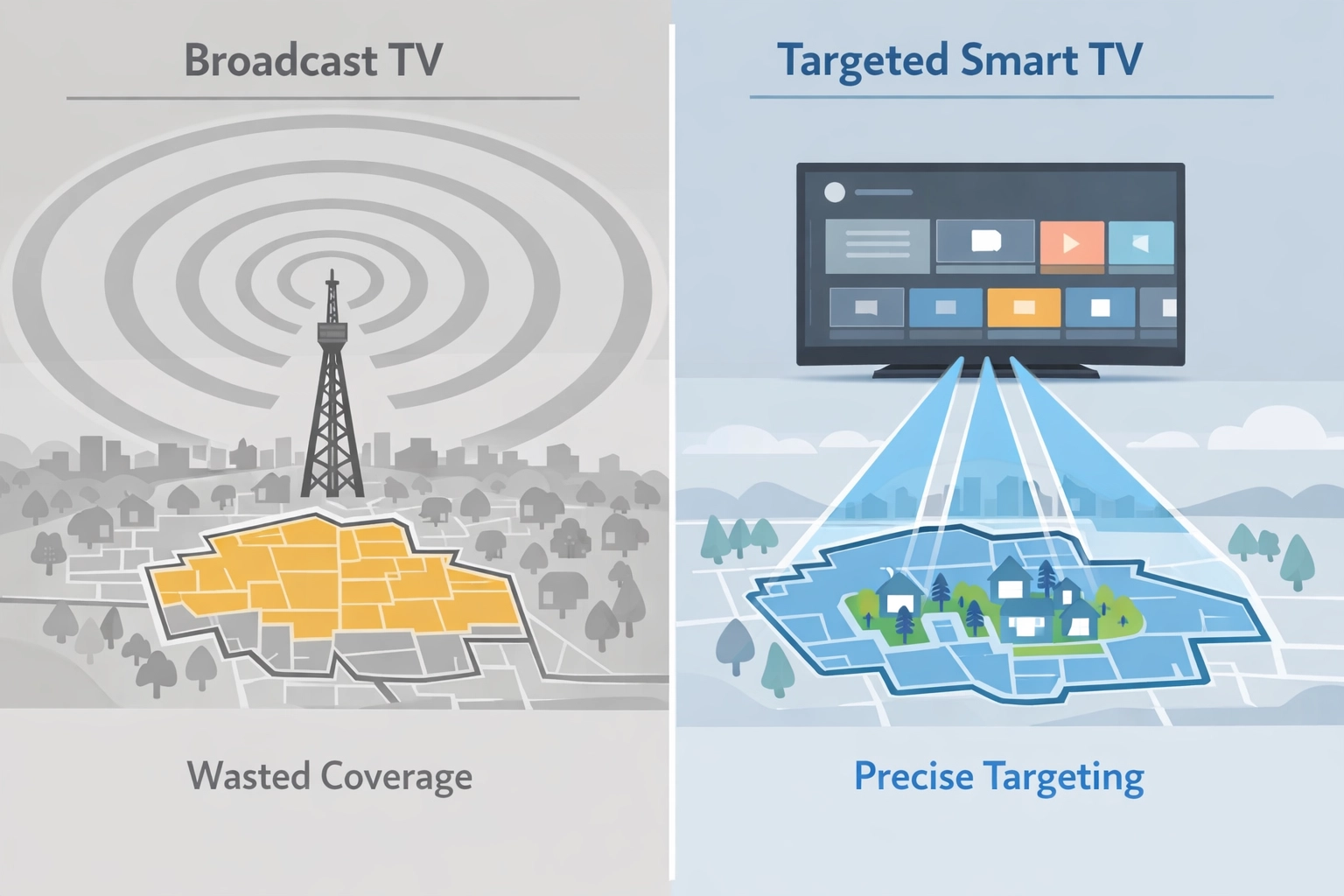
Compare that to broadcast TV's effective CPM of $30-100+ and you start to see why campaigns are moving dollars away from cable. You're not just saving money. You're reaching the exact voters you need without paying for wasted impressions outside your district.
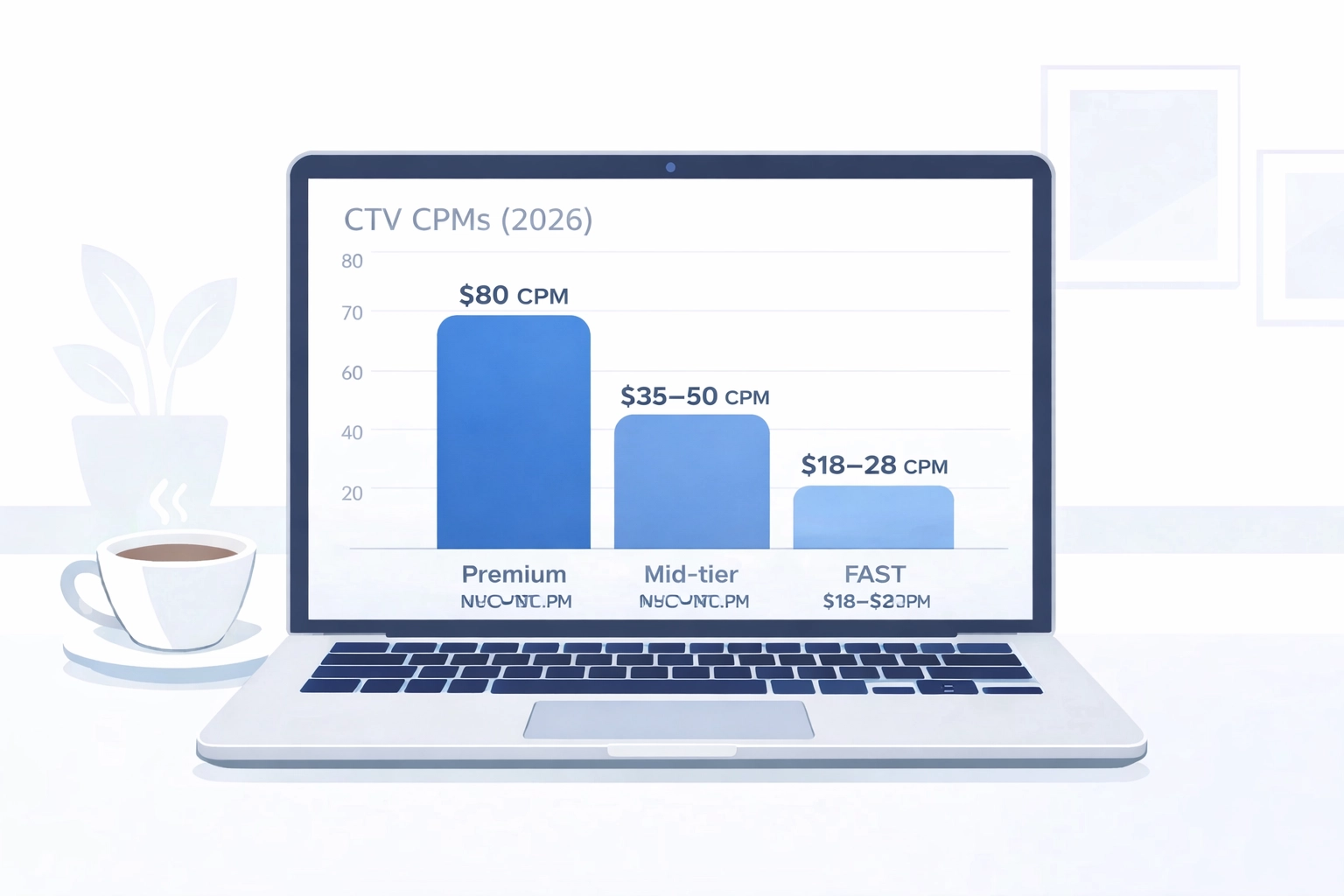
Here's how CPM pricing breaks down by platform tier:
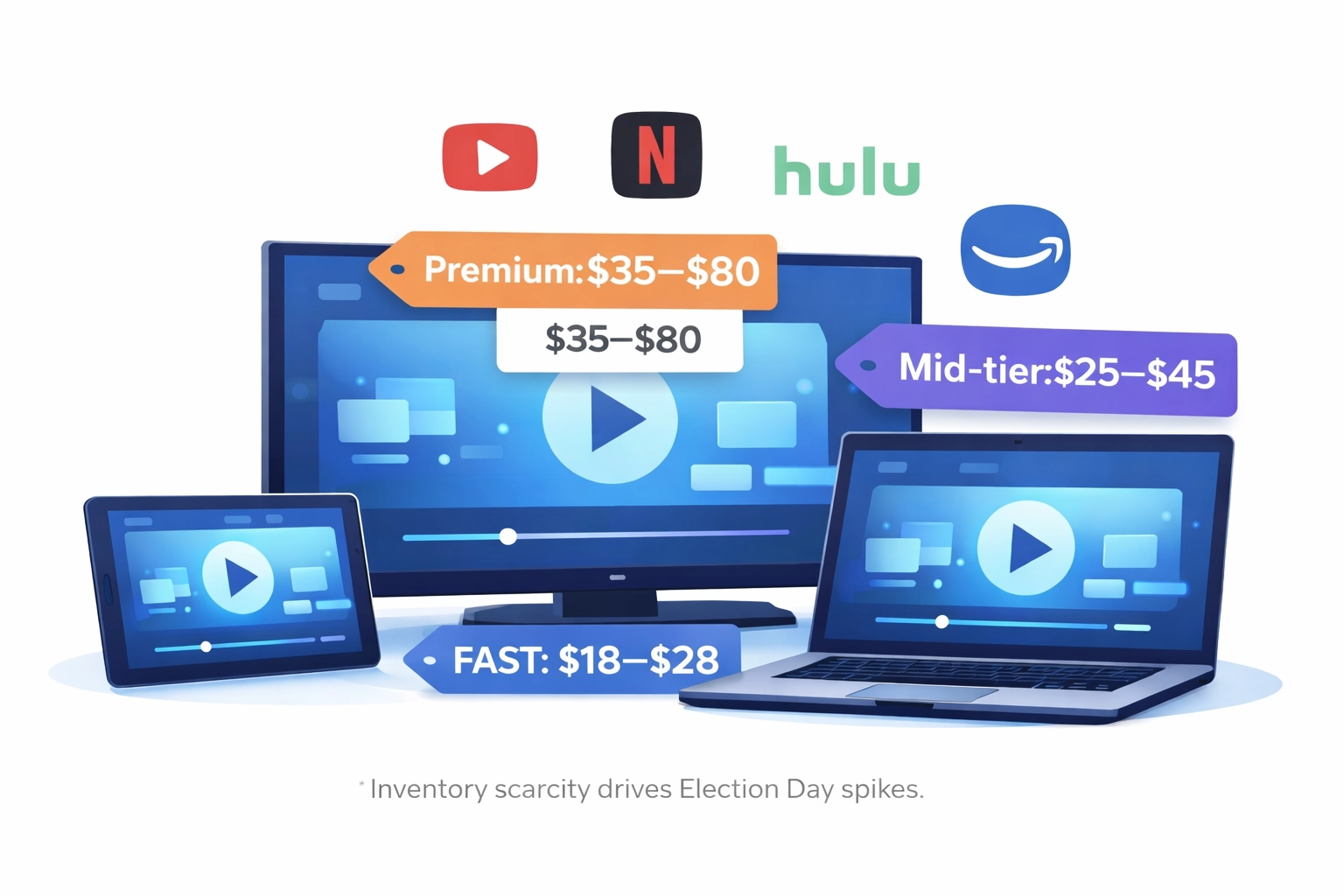
Premium inventory(Hulu, Peacock, Paramount+): $35-80 CPM
Mid-tier platforms(Roku, Samsung TV+): $25-45 CPM
FAST channels(Tubi, Pluto TV): $18-28 CPM
Programmatic mix average: $25-60 CPM
Key takeaway: As you get closer to Election Day, pricing spikes fast —inventory gets scarce and CPMs climb.
Notice the spread. That $33 difference between FAST channels and premium inventory is where smart campaigns win. You don't need to blow your entire budget on Hulu's premium placements; spread it across platforms and delivery channels to achieve an affordable media mix that's still a fraction of the cost of traditional TV (or a piece of mail).
What Does That Mean in Real Campaign Dollars?
Let's get practical. You're not buying CPMs, you're buying votes.
A $500 campaign at $35 CPM delivers approximately 14,300 targeted impressions. For a school board race or city council campaign, that's meaningful reach inside your district, without paying for eyeballs three counties over.
Scale it up: A $2,000 CTV campaign delivers 57,000+ impressions to your exact target audience. That's often more effective than a single broadcast TV spot that costs the same but reaches a massive geographic area where 70% of viewers can't even vote for you.
Now think bigger. A congressional district needing 1.8 million impressions to reach 60% of households 10 times (the research-backed frequency for message retention) costs approximately $63,000 at $35 CPM. That's a fraction of what traditional TV demands for the same reach.
Bottom line: CTV lets you compete without needing a seven-figure media budget. You're not outspending your opponent: you're outsmarting them.
How to Keep CTV Costs Down Without Sacrificing Results
Here's how campaigns using Turn It Blue Ads keep costs low while maximizing impact:
1. Start with FAST Channels and Mid-Tier Platforms
Don't fall into the trap of thinking you need exclusively premium inventory to win. Tubi and Pluto TV run $18-28 CPM: that's still meaningfully cheaper than premium inventory in the $35-80 CPM range, especially when targeting is tight and avails are limited. These platforms still reach millions of voters streaming content on their TVs, just without the brand-name markup.
Mid-tier platforms like Roku, Peacock and Samsung TV+ hit the sweet spot at $25-45 CPM. You're getting high-quality inventory without paying the premium tax.
Add on Hulu, ESPN, and other premium providers to layer on top and ensure your ads are seen across a multitude of platforms.
2. Use Self-Serve Platforms (and Skip the Middleman)
Traditional TV buyers require $5,000-10,000 minimums before they'll even talk to you. That's a barrier most down-ballot campaigns can't afford.
Self-serve platforms eliminate minimums entirely. Turn It Blue Ads lets campaigns launch for as little as $500: no contracts, no middlemen taking a cut, no hidden fees. You control your budget, your targeting, and your creative. That's how we've helped campaigns achieve an 85% win rate while keeping costs transparent.

3. Leverage Precise Targeting to Stretch Every Dollar
CTV's real advantage isn't just lower CPMs: it's precision. You're not paying to reach the entire metro area. You're targeting by zip code, voter file data, and even household demographics and behavioral traits using partners like L2 and Tunnl.
When you eliminate waste, your effective CPM drops even further. If broadcast TV costs $40 CPM but only 30% of viewers are in your district, your real cost-per-in-district-impression is $133. CTV at $35 CPM with 90%+ in-district targeting? Your effective cost stays at $39.
That's a 4.7x efficiency gain. That's the difference between stretching a $10,000 budget and blowing through it in 48 hours.
4. Adjust Your Allocation Based on Race Size
Not every campaign needs the same mix. Here's the rule of thumb:
- For campaigns under $50,000: Allocate 40-60% to CTV/streaming and 30-40% to programmatic display and video. Skip broadcast TV entirely: it's budget suicide for local races.
- For campaigns $50,000-250,000: Scale CTV to 50-70% of your budget. You're still getting better ROI than traditional TV.
- For campaigns $250,000+: CTV should anchor your media strategy at 40-60%, with the rest split across programmatic display and digital video.
The key is matching your spend to your district size. A city council race doesn't need statewide broadcast. A congressional race doesn't need national cable.
Why Turn It Blue Ads Keeps Your Costs Transparent
Here's what sets us apart: we don't hide the ball on pricing.
When you log into the platform, you see exactly what you're paying per impression, across platforms and audience segments. No markups. No agency fees disguised as "creative services." Just clean, transparent pricing that lets you make smart decisions.
We also don't force you into long-term contracts or massive minimums. Launch a $500 test campaign. See how CTV performs for your district. Scale up when you're ready.
That's how we've helped progressive campaigns win 85% of their races—and earned the 2025 Award for 'Best Political Service Team' from Campaigns & Elections Magazine. We're not just a vendor. We're a partner who wants you to win without getting nickel-and-dimed.
The Market is Moving Fast: And So Should You
CTV is projected to capture $2.5 billion in political ad spend in 2026: that's 23% of total political advertising. It's growing twice as fast as broadcast TV because campaigns are finally realizing they don't need to light money on fire to reach voters.
The campaigns that win in 2026 will be the ones that move budget away from wasteful broadcast buys and into precision-targeted CTV. They'll use platforms that give them control, transparency, and flexibility.
You don't need a million-dollar budget to compete. You need a smart strategy, clean data, and a platform that treats you like a partner instead of a transaction.
Ready to see what your CTV campaign could actually cost? Get started with Turn It Blue Ads and launch your first campaign with full transparency: no surprises, no hidden fees, and a $500 minimum that actually respects your budget.
Let's win this thing.
Share this Content!