

Do You Really Need the Lowest CPM Possible? The Truth About Political Display Ads
Do You Really Need the Lowest CPM Possible? The Truth About Political Display Ads
![[HERO] Do You Really Need the Lowest CPM Possible? The Truth About Political Display Ads](https://cdn.marblism.com/BswOlOdUPx2.webp)
You’re staring at a campaign dashboard, and the numbers look incredible. Your Cost Per Mille (CPM) is hitting rock bottom: maybe you’re seeing $1.50 or $2.00. On paper, you’re a hero. You’re stretching every donor dollar to its absolute limit, blanketing the internet with your candidate’s face.
But then the internal polling comes back. Your name ID hasn’t budged. Your "persuadable" universe doesn't seem to know you exist.
Here is the cold, hard truth: The lowest CPM is often the most expensive mistake a political campaign can make.
In the world of digital ads for political campaigns, there is a massive difference between "buying impressions" and "buying influence." If you’re chasing the lowest possible price point, you aren't just saving money: you’re likely buying digital landfill.
At Turn It Blue Ads, we’ve seen how this "race to the bottom" ends. It ends with lost elections. We don’t want that for you. We want you to win, which is why our platform is built on quality, precision, and high-impact inventory.
The Myth of the "Average" CPM
What is the average cpm for display ads in 2026? If you look at general commercial benchmarks, you might see figures ranging from $2.00 to $5.00. But political advertising is a different beast entirely.
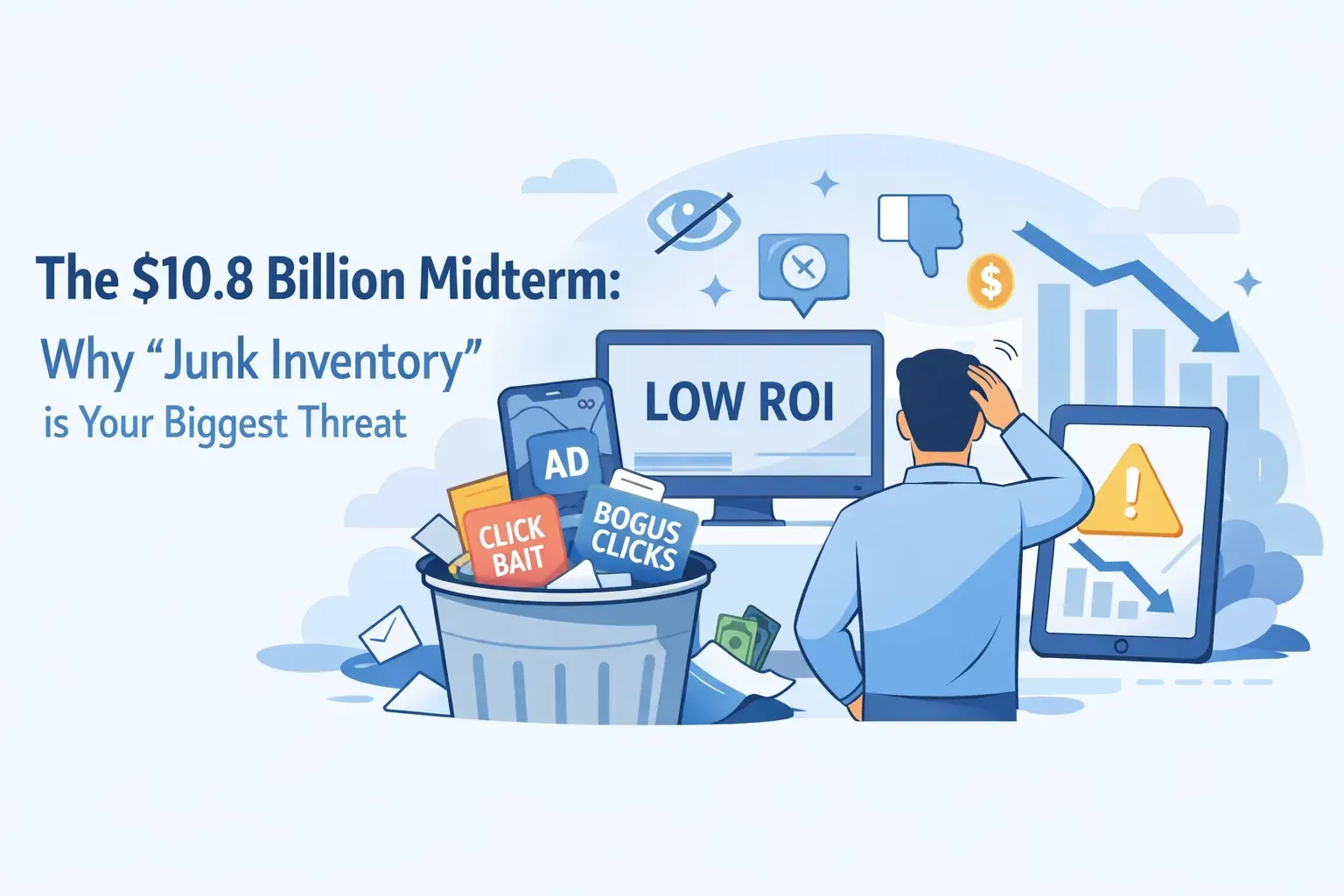
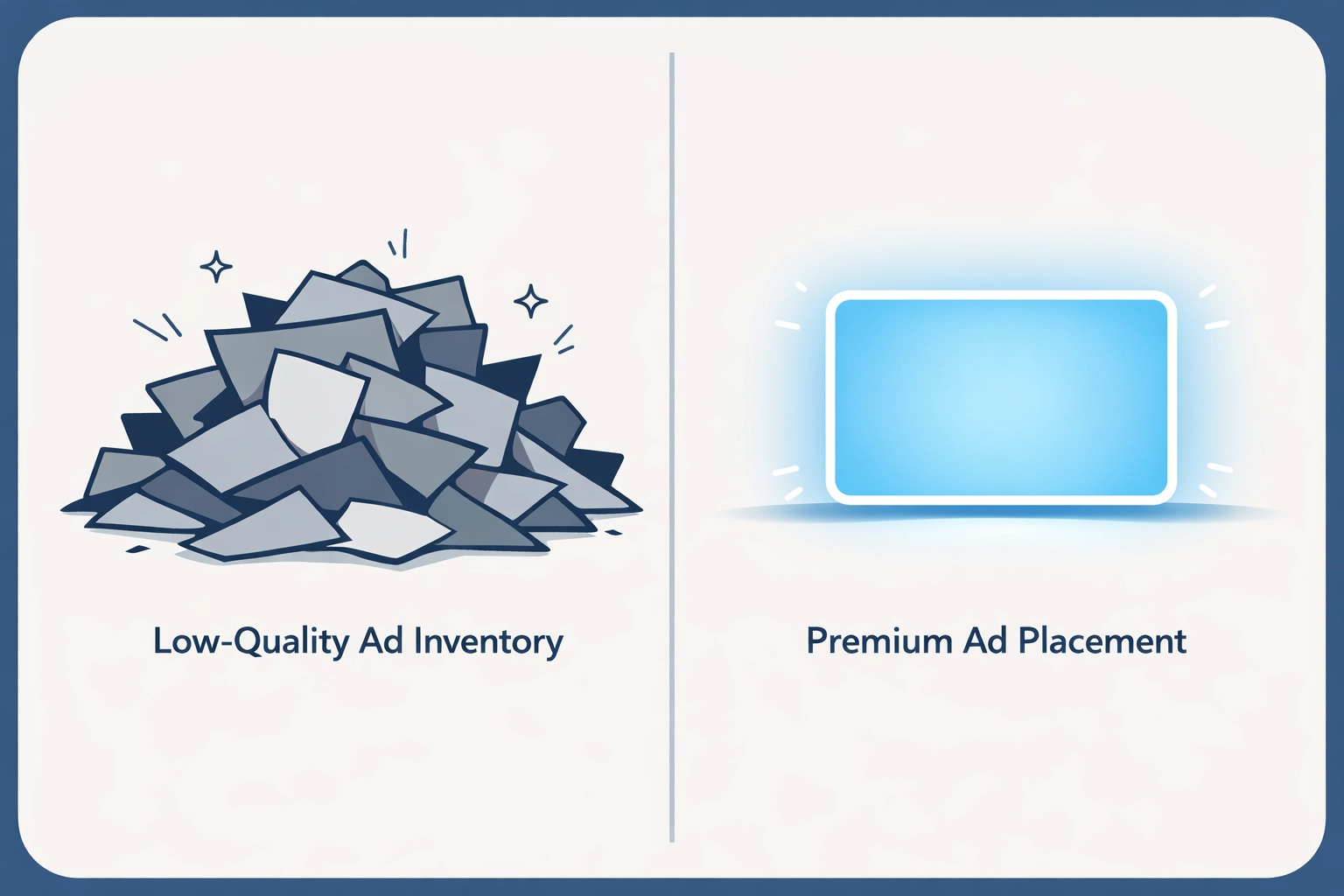
When you buy "cheap" display, your ads often end up on "Made For Advertising" (MFA) websites: those cluttered, bottom-of-the-barrel blogs filled with clickbait and auto-refreshing ad units. Your ad might technically "load," but was it seen? Was it even on the screen for more than half a second? Probably not.
Cheap CPMs prioritize quantity over quality every single time.
If you pay $2.00 for 1,000 impressions on a site no one reads, you’ve wasted $2.00. If you pay $12.00 for 1,000 impressions on a premium news site where your target voter is actually reading a local story, you’ve made an investment.
Why "Winning" is a Better Metric Than "Reach"
For most businesses, digital ads are about top-of-funnel awareness. For a political campaign, digital ads are about one thing: getting to 50% plus one on Election Day.
You aren't trying to sell a pair of shoes to anyone with feet; you are trying to move a specific group of people in a specific geographic area within a specific window of time. This requires a level of precision that "cheap" programmatic networks simply cannot provide.
Efficiency is not the same thing as being cheap.
Research actually shows that digital advertising can be 14 to 65 times more cost-effective than broadcast television. Why? Because 70-85% of a typical TV buy reaches people who can’t even vote for you. They live in the wrong district, or they aren't registered. When you use modern campaigns strategies, you stop paying to talk to people who can't help you win.
The Danger of Junk Inventory
When you demand the lowest CPM, the algorithms behind the scenes respond by finding the cheapest possible "real estate" on the internet. This leads to several disastrous outcomes for your campaign:
- Invisible Placements: Your ad might be tucked away at the very bottom of a page (below the fold) where no human eye ever wanders.
- Ad Fraud: Cheap inventory is a playground for bots. You might be paying for "views" generated by a server farm in a different country.
- Brand Safety Risks: Your candidate's "Protect Our Schools" ad could end up next to extremist content or adult-themed clickbait.
- Zero Frequency: To win, a voter needs to see your message multiple times. Spreading your budget too thin across low-quality sites means you’re hitting a million people once, rather than the right 10,000 people eight times.
Bottom line: If the price seems too good to be true, you aren’t the one doing the targeting: you’re the one being sold junk.
Precision Targeting:
So, how do you avoid the junk? It starts with the data.
Many platforms rely on outdated or broad demographic data. At Turn It Blue Ads, we believe your strategy is only as good as your audience list. That’s why we prioritize Tunnl and L2 data.
Tunnl specializes in deep-issue-based modeling. Instead of just targeting "Democrats aged 35-50," we can target "Persuadable voters who care about healthcare costs and live in Precinct 402." This level of granularity ensures that every cent of your budget is working toward a conversion: whether that's a donation, a volunteer sign-up, or a vote.
By using high-quality data and premium inventory, you might see a higher CPM than the "average" on a generic dashboard. But your Cost Per Effective Impression will be much lower. You are paying for a seat at the table where the decisions are made, not just a flyer on a windshield in a parking lot.

Quality Ad Production Matters Too
It isn't just where your ad goes; it’s what it looks like when it gets there. If you’re going to pay for premium inventory, don't show up with a lackluster creative.
We offer a range of display ad templates and custom ad production services that are designed specifically for the political space with the visual hierarchy needed to move voters.
When you combine high-impact creative with premium placements, you create a "surround sound" effect for the voter. They see your ad on a reputable local news site, then they see it again while checking the weather, and it looks professional, credible, and urgent.
How Turn It Blue Ads Built an 85% Win Rate
We don’t just talk about quality: we have the track record to prove it. Sine 2020, clients using the Turn It Blue Ads platform have seen an 85% win rate.
That didn't happen by accident. It happened because we refused to "nickel and dime" our clients into low-quality inventory. We focus on what works. Our team was even awarded the 2025 Award for 'Best Political Service Team' by Campaigns & Elections Magazine (C&E). We take the guesswork out of digital ads for political campaigns so you can focus on the stump speech and the doors.
You don't need a million-dollar budget to play in this space, either. While some agencies won't even pick up the phone for less than $50,000, we’ve made it possible to launch a professional, high-quality campaign with only a $500 minimum to get started.
This means a town council candidate or a local school board member can access the same high-tier inventory and targeting data as a gubernatorial race.
Why You Should Invest in CTV and Premium Display
If you’re looking at your 2026 budget, you have to decide where your "must-haves" are.
We’ve written extensively about why programmatic CTV will consume $1.3B this cycle. Connected TV (CTV) often has a much higher CPM than display ads: sometimes $40 to $80. Does that make it a bad deal?
Absolutely not.
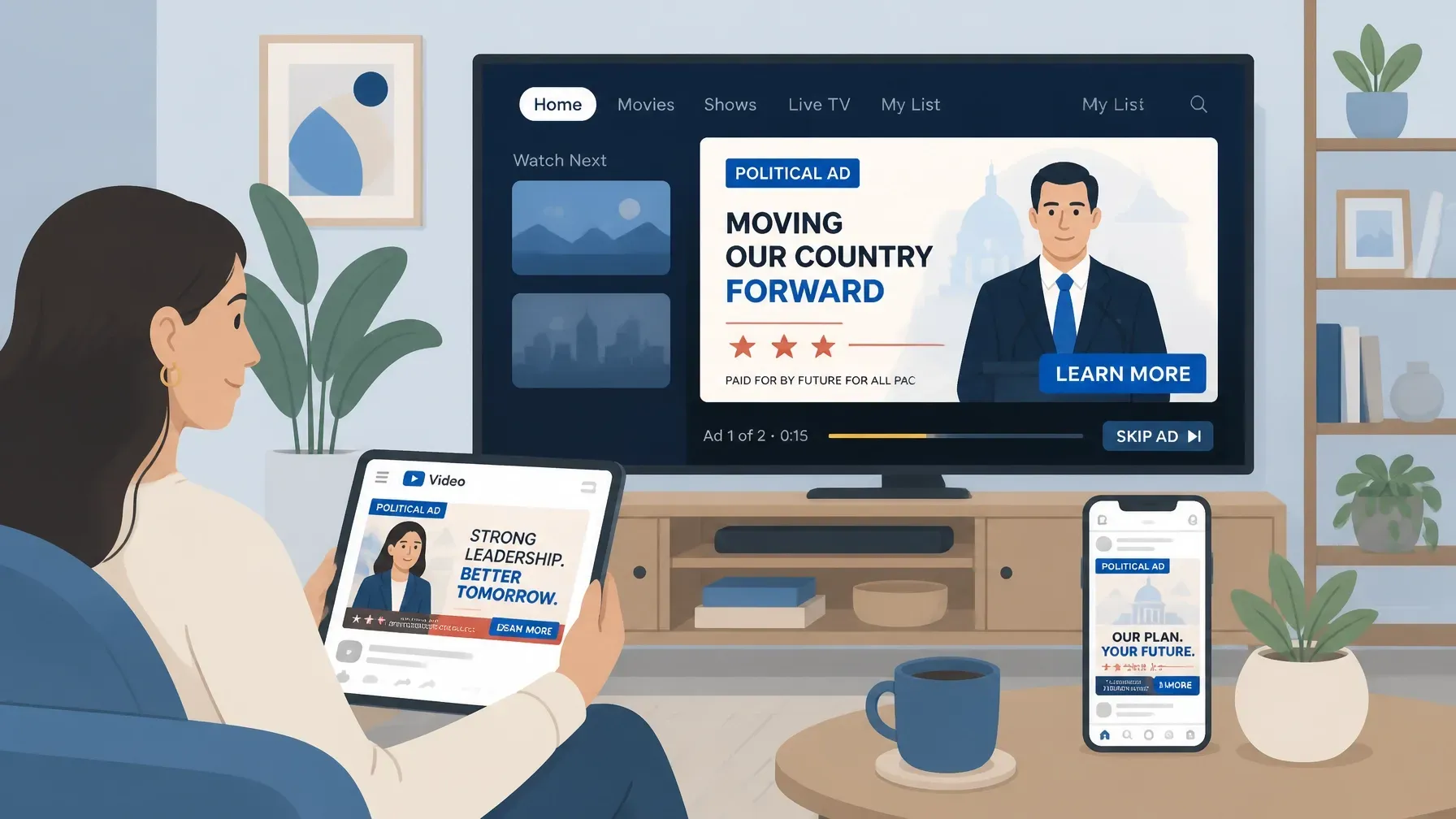
CTV offers 95%+ completion rates and a "big screen" experience. When you pair CTV with high-quality display pre-roll video retargeting, you’re creating a cross-device playbook that follows the voter from their living room to their smartphone. You can learn more about this in our guide on how CTV retargeting works in 2026.

The Truth About the "Budget Competition"
Let’s be real: You are competing on budget. You’re competing for the attention of the same 5,000 undecided voters as your opponent.
If your opponent spends $5,000 on "cheap" ads and gets 2 million junk impressions, and you spend $5,000 on "premium" ads and get 400,000 high-quality impressions, you are winning. Why? Because your 400,000 impressions were actually seen by the people who decide the election. Your opponent’s 2 million impressions were mostly seen by bots or ignored on the sidebar of a recipe blog.
Don't let a low CPM hide a failing strategy.
Here’s How to Get Started the Right Way
If you’re ready to stop chasing vanity metrics and start building a winning digital presence, here is the path forward:
- Define your universe: Use Tunnl data to find exactly who needs to hear your message.
- Focus on Frequency: Aim for 8-12 touch-points per voter. It’s better to be famous to a small group than a stranger to everyone.
- Choose Quality Over Quantity: Prioritize premium news and local sites over the "open web" junk.
- Launch with Turn It Blue Ads: Our platform is designed by political pros who know that at the end of the night, the only metric that matters is the vote count.
Ready to see the difference quality makes? You can start your digital ad plan today with as little as $500.
Key Takeaway:
The "average" CPM is a trap. In political advertising, you aren't buying a commodity; you are buying the ability to persuade. Cheap inventory leads to invisible ads, wasted funds, and missed opportunities. By investing in premium inventory and precision data, you ensure that every dollar you spend is a dollar spent on winning.
Get Started Today! Take a look at our store to browse templates or meet with our team to discuss your 2026 strategy. Let’s get to work.
Share this Content!